Why We Changed Our Line — and What "Built for What's Next" Really Means

By Scott Borhauer, Founder, Smart Life Financial
A few weeks ago, we retired our old tagline and replaced it with six words:
Built for what's next. Strategy for the world that's coming — not the one that's gone.
I want to tell you why — because the reason isn't marketing. The reason is the world.
The line is blurring
Think about how much has changed in just the last few years.
Money used to be paper in your wallet. Now it's numbers on a screen. A "meeting" used to mean a room. Now it's a video window. A voice on the phone used to prove a person was real. Now it doesn't. The line between what's real and what's virtual is getting harder to see every single month — and it's not slowing down. It's accelerating.
Here's what nobody in the financial industry wants to say out loud: the pace of change we're living through right now compresses ten or twenty years of disruption into every twelve months. Digital money. Machine-driven markets. Industries reinventing themselves overnight. The rules your parents retired under simply do not exist anymore.
That's not a reason to be afraid. It's a reason to have a plan.
We're at a tipping point — and the math proves it
I'm a numbers person, so let me show you the numbers instead of just telling you a story.
The Social Security clock. Based on the 2026 Trustees Report, the retirement trust fund is projected to run short in the fourth quarter of 2032. When that happens, the program can only pay what it collects — about 78 cents of every dollar you were promised. That's an automatic 22% cut: a $3,000 monthly benefit becomes $2,340 unless Congress acts. And 22% is only the starting point — the gap between what's promised and what's collected keeps widening every year after the fund runs dry. That's why the Committee for a Responsible Federal Budget, working from the Chief Actuary's own projections, puts the cut for people retiring just after insolvency at 24% — 76 cents on the dollar, roughly $500 a month off the typical check. The official floor is 22%. The likely reality is worse. That's not a prediction. That's arithmetic that's already published.
The IRA tax bomb. Trillions of dollars sit in traditional IRAs and 401(k)s across this country — and every single dollar of it is pre-taxed. The IRS owns a piece of your account, and at age 73 — or 75 if you were born in 1960 or later — Required Minimum Distributions force you to start paying whether you need the money or not. Bigger withdrawals push you into higher brackets, make more of your Social Security taxable, and drive up your Medicare premiums. It stacks.
The old model can't keep up. The traditional advisor puts you in a fund, charges a fee forever, and reacts to whatever the market does. That model was built for a slow world. We don't live in a slow world anymore.
Any one of these would be a challenge. All three at once, arriving in the same decade the world goes digital? That's a tipping point. And at a tipping point, standing still is a decision — usually the most expensive one.
Why "Built for what's next"
We didn't choose those words because they sound good. We chose them because they describe the job.
Our clients don't hire us to explain what already happened. They hire us to see what's coming and position them ahead of it. That's the difference between an advisor and a strategist. An advisor responds. A strategist anticipates.
"Built" matters too. A plan isn't advice you receive — it's something constructed, tested against real math, and executed step by step, year by year. We don't hand you a document and disappear. We build with you, and we keep building as the world changes, because it will.
And "what's next" is deliberately yours to define. For some of our families, what's next is grandchildren and a trust that protects three generations. For others, what's next is simpler and just as important: the next thirty years of retirement income that cannot run out, no matter what the market or Congress does. Both of those futures deserve a plan built on purpose.
Pivoting isn't panic. It's strategy.
Here's the mindset shift I want to leave you with. When the world changes this fast, the winners aren't the people who predicted every twist. They're the people who built plans that could pivot — plans with protected floors, guaranteed income, tax-free growth, and room to adapt when the next new thing arrives.
That's what we build at Smart Life Financial. Custom, tax-efficient plans designed around your actual life — shown to you in plain English, with the math on the table, so you understand every move before we make it together.
The world that's gone isn't coming back. The world that's coming is already here.
Let's build for it.
One conversation changes everything. Run your numbers, or book a call — no pitch, no pressure, just the math.
Smart Life Financial | Built for what's next. Strategy for the world that's coming — not the one that's gone.
About the Author
Scott Borhauer
Scott Borhauer is the founder and principal advisor of Smart Life Financial, where he designs retirement income, tax, and estate strategies for federal employees, business owners, and pre-retirees. His work centers on the arithmetic most people never get shown — Roth conversion sequencing, Social Security timing, and the tax cost of doing nothing — and he coordinates with CPAs and estate attorneys to execute the plan, not just write it. Licensed insurance producer, NPN 20016169.
Smart Life Financial Welcome Kit
Our best guides, checklists, and tools — all in one free download.
🎁 Free instant download · Unsubscribe anytime
Related Posts
The Tax Torpedo: The Social Security Cut That Already Happened
Everyone is talking about the 2032 Social Security cut. Almost nobody is talking about the one that already happened — the tax torpedo. It has been quietly taking money out of retirees' pockets for four decades, and it takes a little more every year.
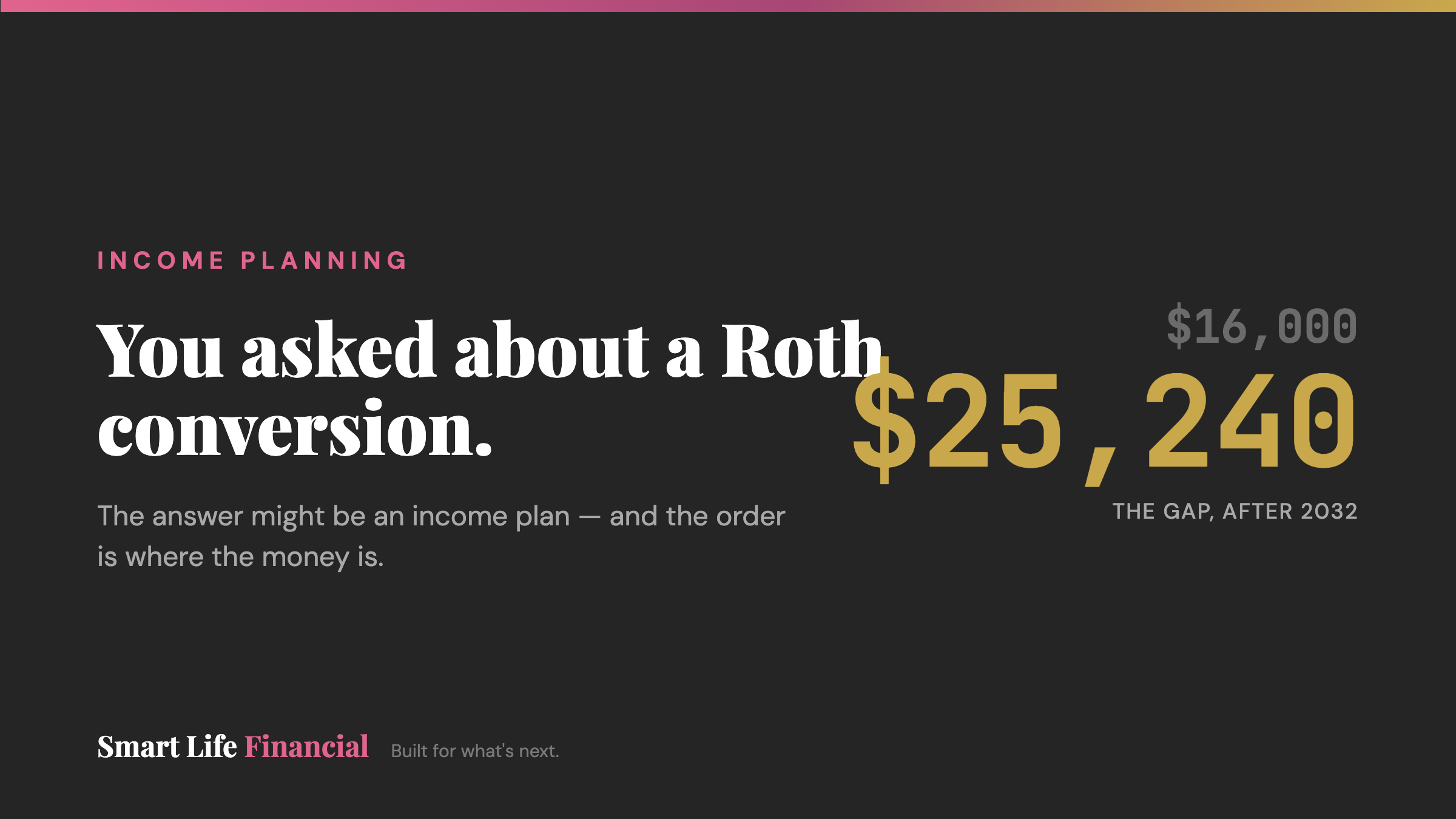
You Asked About a Roth Conversion. The Answer Might Be an Income Plan.
The call usually starts the same way — someone read about Roth conversions and calls saying they need one. Sometimes they're right. A fair number of times, the answer is an income plan, and the order is where the money is.
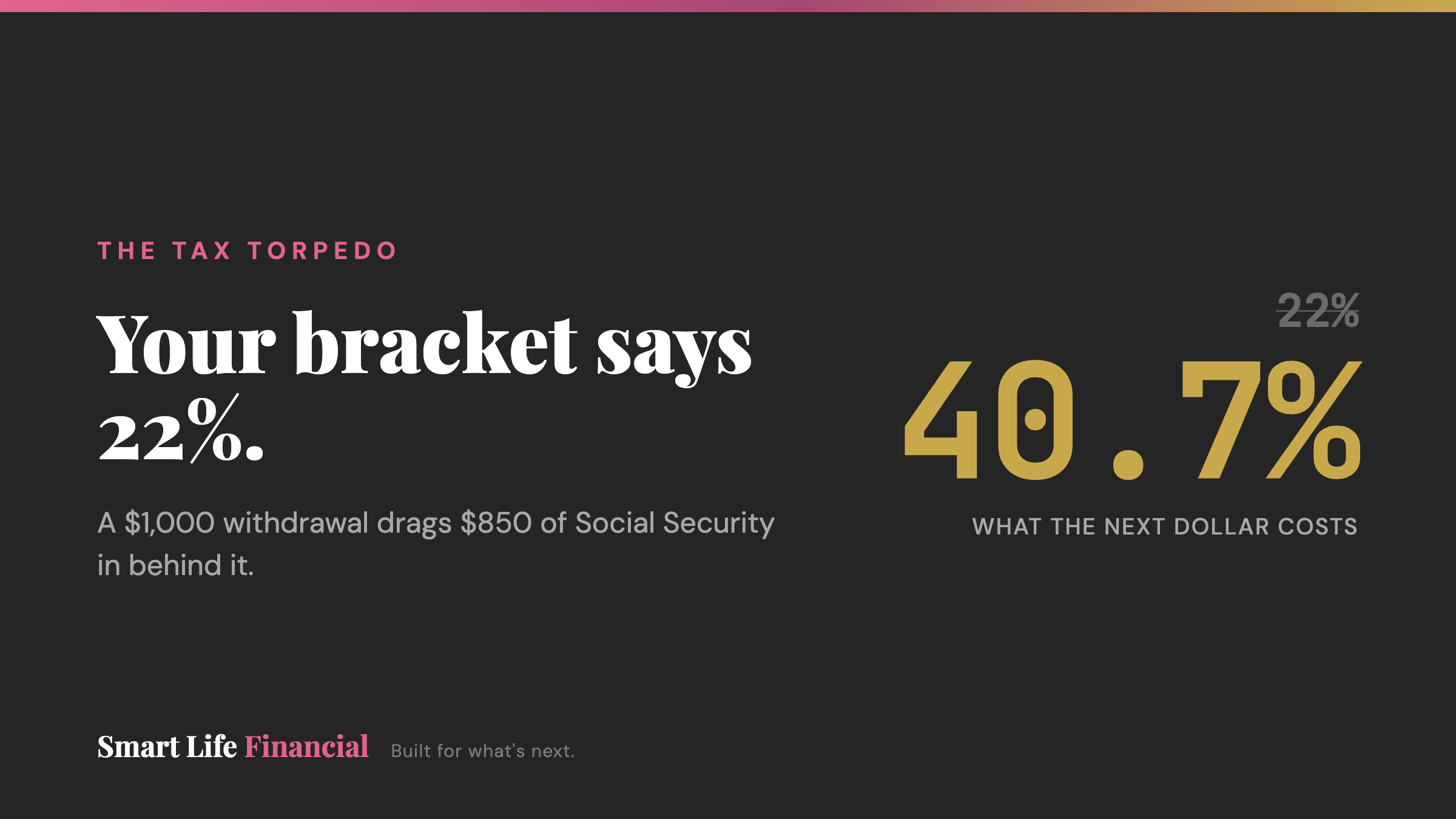
The Other Social Security Cut: The Tax Torpedo Explained
Social Security's taxation thresholds haven't moved since 1984. Here's how a $1,000 IRA withdrawal can cost 40.7% when your bracket says 22% — and what to do.