6 Social Security Rules for Divorced Spouses Most People Don't Know

6 Social Security Rules for Divorced Spouses
Over 40% of people approaching retirement age don't know that a divorce doesn't end your Social Security rights from a former marriage. If you were married long enough, your ex's earnings record may significantly increase your monthly benefit.
Here's exactly how it works.
Rule 1: The 10-Year Marriage Requirement
To claim Social Security benefits on your ex-spouse's record, you must have been married for at least 10 consecutive years and be currently unmarried.
That's the gateway rule. If the marriage lasted 9 years and 11 months, you don't qualify. If it lasted 10 years or more, you do — regardless of how long ago the divorce occurred.
Rule 2: Your Ex's Benefit Is Not Reduced
This is the rule that surprises most people. Claiming on your ex's record has absolutely zero impact on their monthly check. They are not notified. Their current spouse's benefit is unaffected.
The Social Security Administration pays the divorced spouse benefit from its own pool — your ex loses nothing.
Rule 3: Your Ex Doesn't Need to Have Filed
You don't have to wait for your ex-spouse to claim Social Security before you can.
If you've been divorced for at least 2 years and your ex is 62 or older, you can claim your divorced spouse benefit independently — even if they haven't applied for their own benefits yet.
Rule 4: The Maximum Is 50% of Their PIA
At your Full Retirement Age (FRA), the divorced spouse benefit pays up to 50% of your ex's Primary Insurance Amount (PIA) — the benefit they'd receive if they claimed at their own FRA.
If you claim early (before your own FRA): The benefit is reduced. Filing at 62 reduces it to approximately 32.5% of your ex's PIA. There is no benefit to waiting past your own FRA — the divorced spouse benefit does not grow with delayed credits the way your own record does.
Rule 5: Remarriage Ends Eligibility
If you remarry, you lose your eligibility to claim on your ex's record — for as long as that subsequent marriage continues.
However: If that later marriage ends through divorce, death, or annulment, your eligibility to claim on your original ex's record comes back.
Rule 6: If Your Ex Dies, the Rules Change
When your ex-spouse dies, you become eligible for a divorced spouse survivor benefit — which is different from (and larger than) the regular divorced spouse benefit:
- Survivor benefits can begin as early as age 60 (age 50 if you're disabled)
- At your FRA, the survivor benefit equals 100% of your ex's PIA — not 50%
- Remarriage after age 60 does not disqualify you from the survivor benefit
The Most Important Rule: You Get the Higher of the Two — Not Both
You receive whichever is greater — your own Social Security benefit OR the divorced spouse benefit. You cannot receive both simultaneously.
The exception: Survivor benefits. If your ex has died, you can switch from one record to the other at different ages to maximize lifetime income. This is a strategy that requires specific timing and calculation.
Want to Know More? Here's the Truth.
Social Security strategy for divorced spouses is one of the most underutilized income opportunities in retirement planning. The rules are specific, the claiming age matters significantly, and a wrong decision at 62 can cost you tens of thousands of dollars in lifetime benefits.
Scott Borhauer specializes in Social Security optimization — including divorced and surviving spouse strategies — and builds claiming models that account for your full financial picture.
Not individualized financial advice. Social Security rules are complex and subject to change. Consult SSA.gov or a qualified Social Security specialist for your specific situation.
About the Author
Scott Borhauer
Scott Borhauer is the founder and principal advisor of Smart Life Financial, where he designs retirement income, tax, and estate strategies for federal employees, business owners, and pre-retirees. His work centers on the arithmetic most people never get shown — Roth conversion sequencing, Social Security timing, and the tax cost of doing nothing — and he coordinates with CPAs and estate attorneys to execute the plan, not just write it. Licensed insurance producer, NPN 20016169.
Retirement Income Planning Worksheet
Step-by-step worksheet to map out your income streams and find gaps in your plan.
📊 Free instant download · Unsubscribe anytime
Related Posts
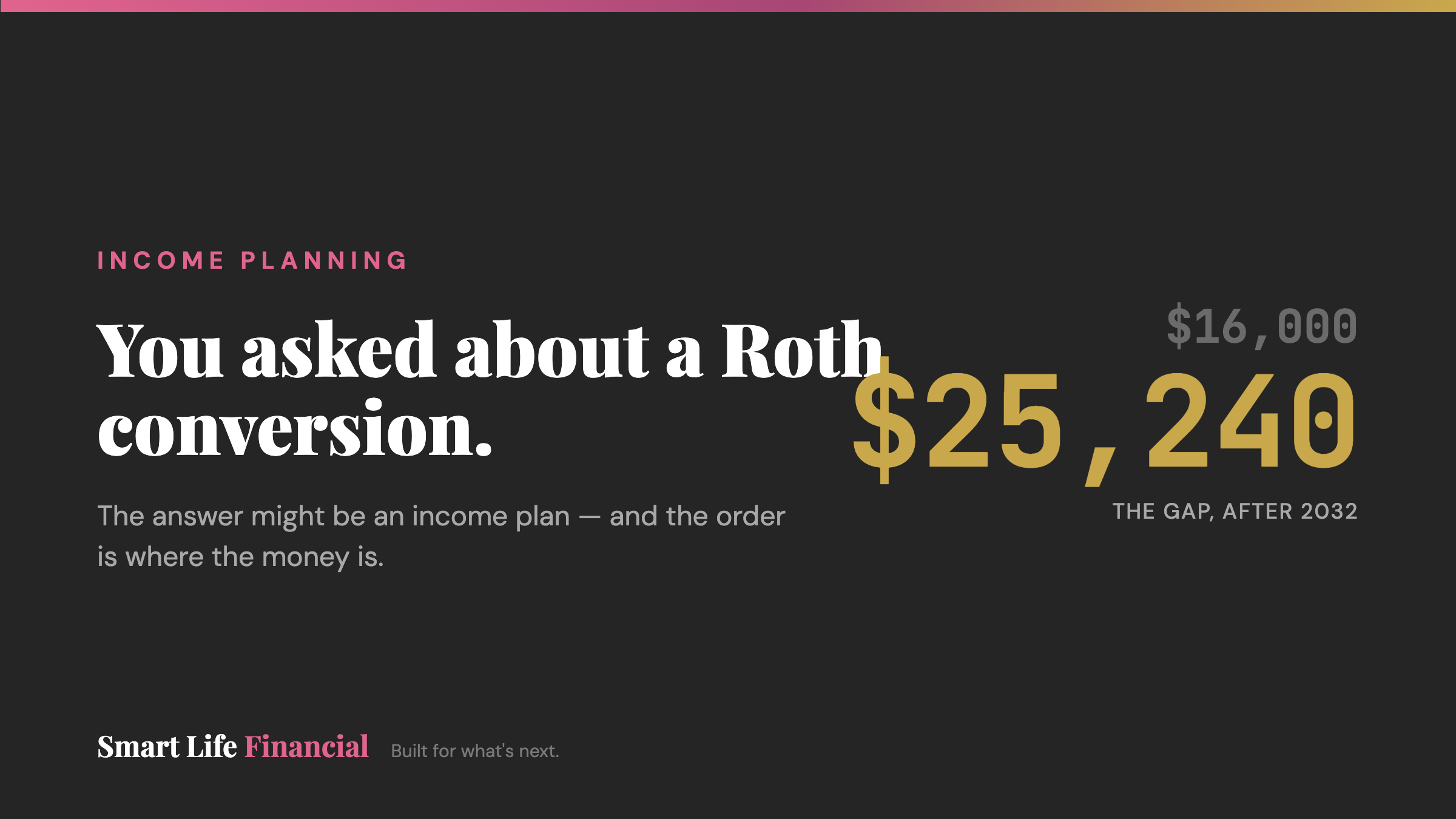
You Asked About a Roth Conversion. The Answer Might Be an Income Plan.
The call usually starts the same way — someone read about Roth conversions and calls saying they need one. Sometimes they're right. A fair number of times, the answer is an income plan, and the order is where the money is.
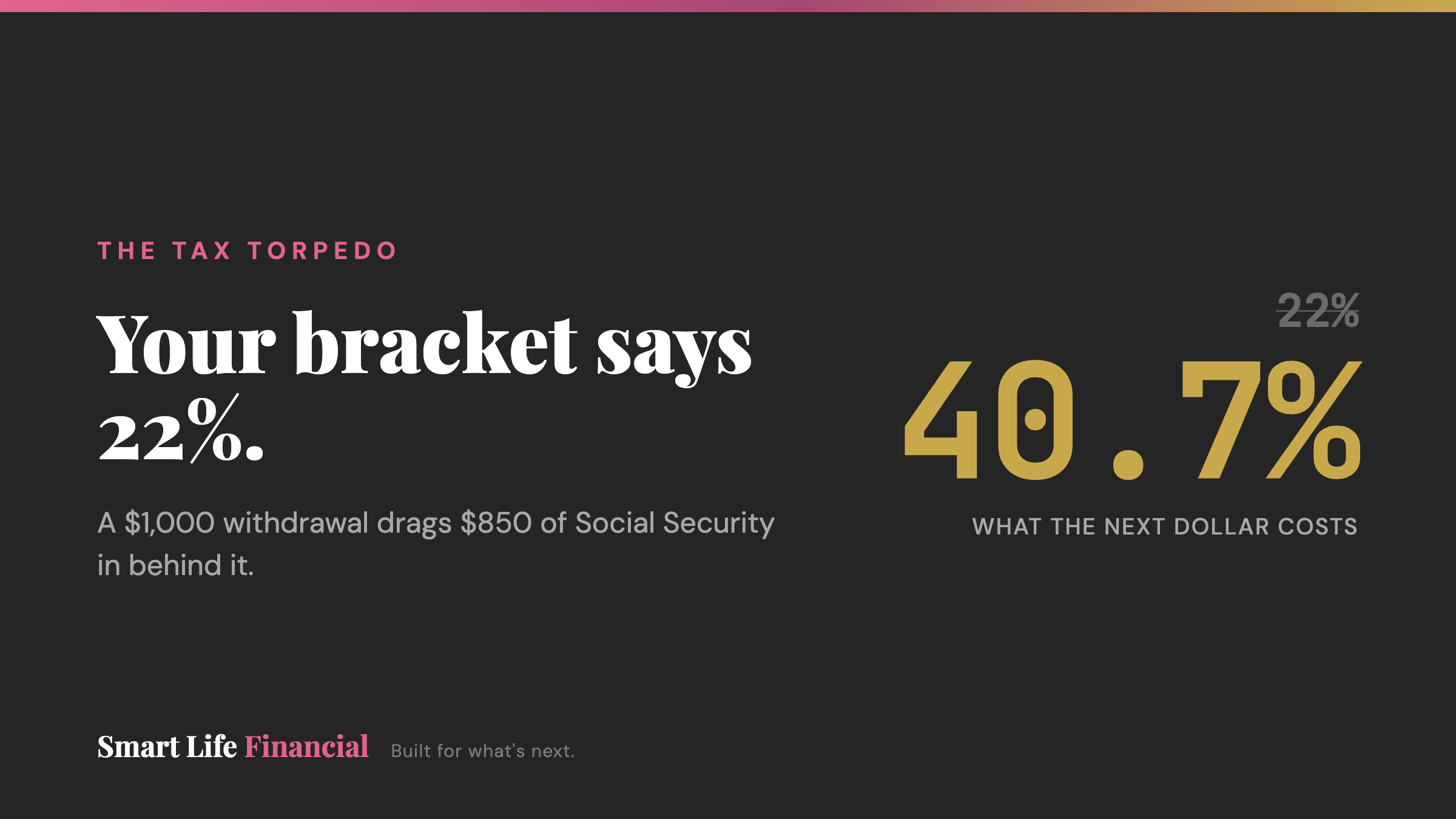
The Other Social Security Cut: The Tax Torpedo Explained
Social Security's taxation thresholds haven't moved since 1984. Here's how a $1,000 IRA withdrawal can cost 40.7% when your bracket says 22% — and what to do.
How a Discount Conversion Actually Works
A discount conversion is a legitimate application of ordinary valuation principles to an unusual asset — and five pressure tests that separate the real thing from the way it is often marketed.