Most business owners who have heard of the Augusta Rule know one number: fourteen. Rent your home to your business for 14 days or fewer, and that rent comes to you federal income tax free.
The fourteen days are the easy part. The part that decides whether the deduction survives an audit is a different number entirely: the daily rate you charged yourself, and whether you can prove where it came from.
This post walks through the rule, the math in real dollars, the court case that shows what happens when the rate is a guess, and the checklist I give business owners before they ever cut the first rent check. Then we go further, because Augusta is one tool in a much bigger tax-reduction stack.
What the Augusta Rule actually is
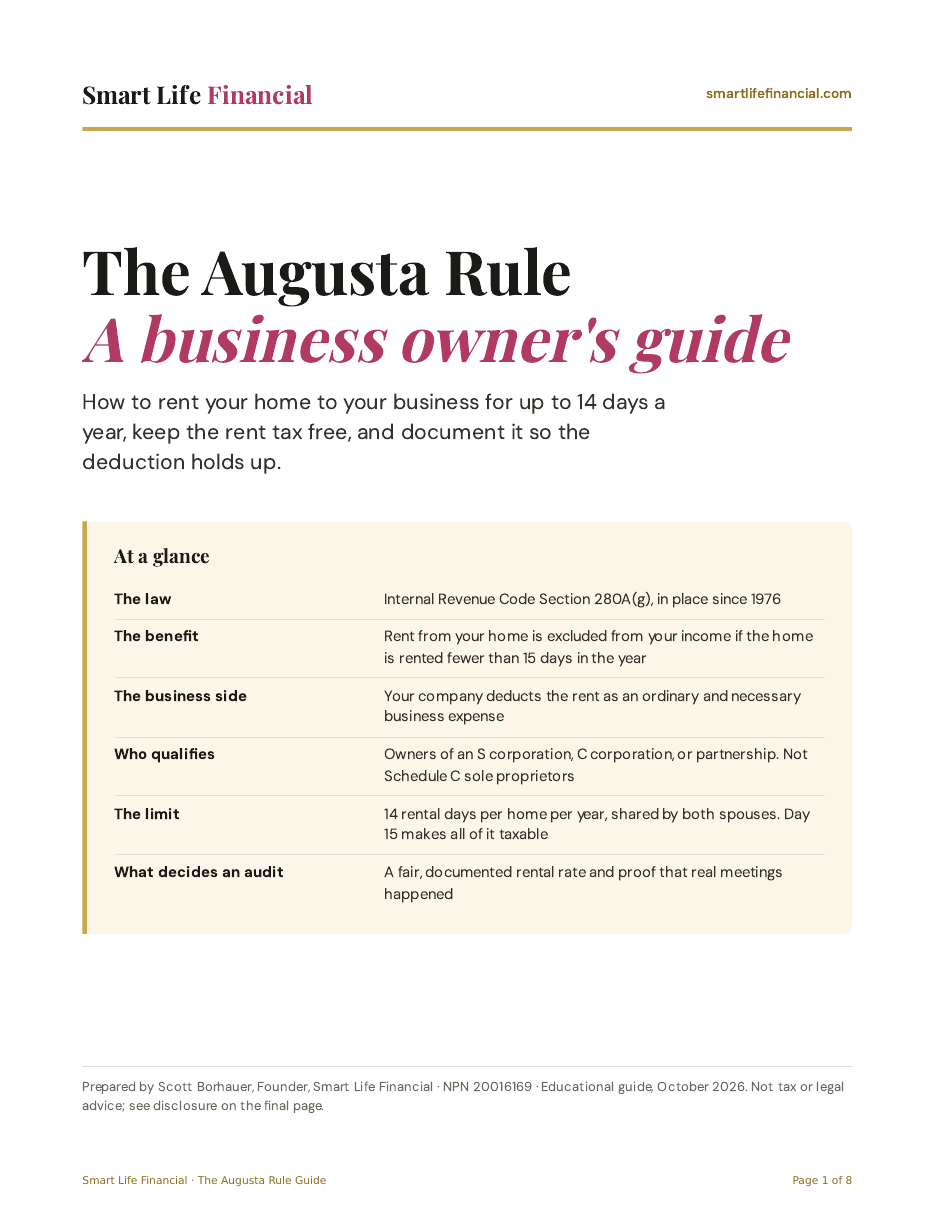
The Augusta Rule is Internal Revenue Code Section 280A(g), on the books since 1976. It says that if you rent out a home you live in for fewer than 15 days in a year, the rent is not income, and you take no rental deductions for those days.
The nickname comes from Augusta, Georgia, where homeowners rent their houses to Masters Tournament visitors every April. Nothing in the statute limits it to golf fans. It applies to any qualifying residence in the country.
Here is how business owners use it:
- Your business needs space for a legitimate meeting: a planning session, a board meeting, a team offsite, a client event.
- Instead of renting a hotel conference room, the business rents your home at fair market rent.
- The business deducts the rent as an ordinary and necessary business expense.
- You, the homeowner, exclude that rent from your personal income, as long as total rental days for the home stay at 14 or under.
Three rules worth knowing up front. The 14 days do not need to be consecutive. Married couples share one 14-day limit per home, not 14 each. And day 15 is a cliff: rent the home 15 days and all of the rent becomes taxable, not just the fifteenth day.
Who can use it, and who can't
The business version of the Augusta Rule needs two taxpayers: a business that pays and deducts the rent, and a homeowner who receives and excludes it. If you and your business file one return, there is nobody to pay you.
| Business structure | Can it rent your home? | Why |
|---|---|---|
| S corporation | Yes | Separate entity that pays and deducts the rent |
| C corporation | Yes | Deducts the rent against its own income |
| Partnership or multi-member LLC | Yes | Partnership deducts; the partner excludes |
| Single-member LLC with S corp election | Yes | Taxed as an S corporation |
| Sole proprietor (Schedule C) | No | You and the business are one taxpayer |
| Single-member LLC, disregarded | No | The IRS sees one individual |
If you run a Schedule C business, the conversation starts with entity choice, not a rental agreement. An S corp election can make sense, but weigh it on your whole tax picture, not one deduction.
The number is the strategy
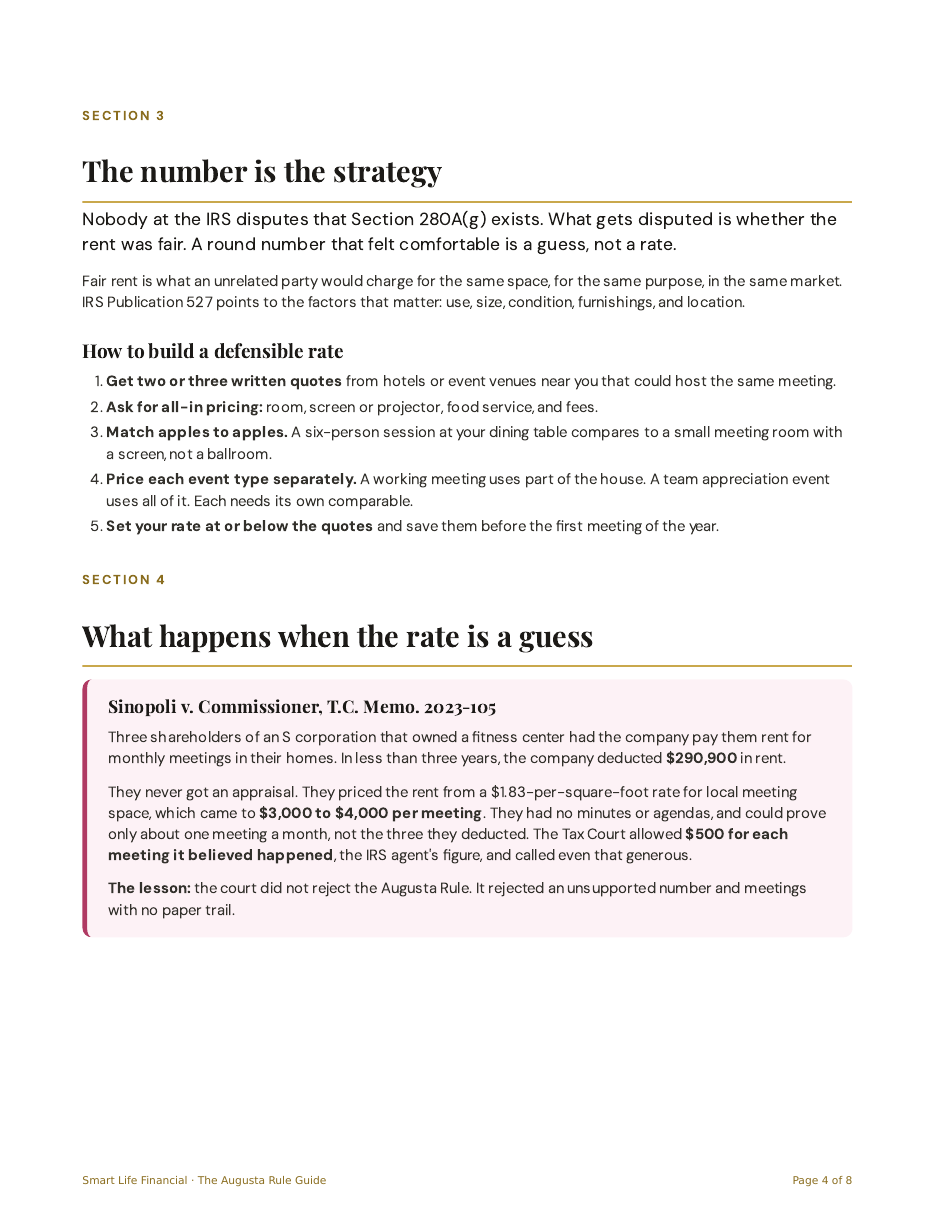
Nobody at the IRS argues whether Section 280A(g) exists. What gets argued is whether the rent was fair. A round number that felt comfortable is not a rate; it is a guess.
Fair rent means what an unrelated party would charge for the same space, for the same purpose, in the same market. IRS Publication 527 points to the factors that matter: use, size, condition, furnishings, and location. In practice, that means real quotes.
How to build a defensible rate:
- Call two or three hotels or event venues near you that could host the same meeting.
- Get written, all-in quotes: room, screen or projector, food service, and fees.
- Match apples to apples. A six-person planning session at your dining table compares to a small meeting room with a screen, not a ballroom.
- Price different events separately. A working meeting uses part of the house. A holiday party for the team uses all of it. Each gets its own comparable.
- Set the rate at or below the quotes, and save them in an Augusta file before the first meeting.
What happens when the rate is made up
The case every advisor should know is Sinopoli v. Commissioner, T.C. Memo. 2023-105. Three shareholders of an S corporation that owned a fitness center had the company pay them rent for monthly meetings in their homes. In less than three years, the company deducted $290,900 in rent.
They never got an appraisal. They priced the rent from a $1.83-per-square-foot rate for local meeting space, which came to $3,000 to $4,000 per meeting. They had no minutes or agendas, and could prove only about one meeting a month, not the three they deducted. The Tax Court allowed $500 for each meeting it believed happened, the IRS agent's figure, and called even that generous.
The court did not reject the Augusta Rule. It rejected the number, and it rejected meetings with no paper trail. That is the lesson.
The math in plain English
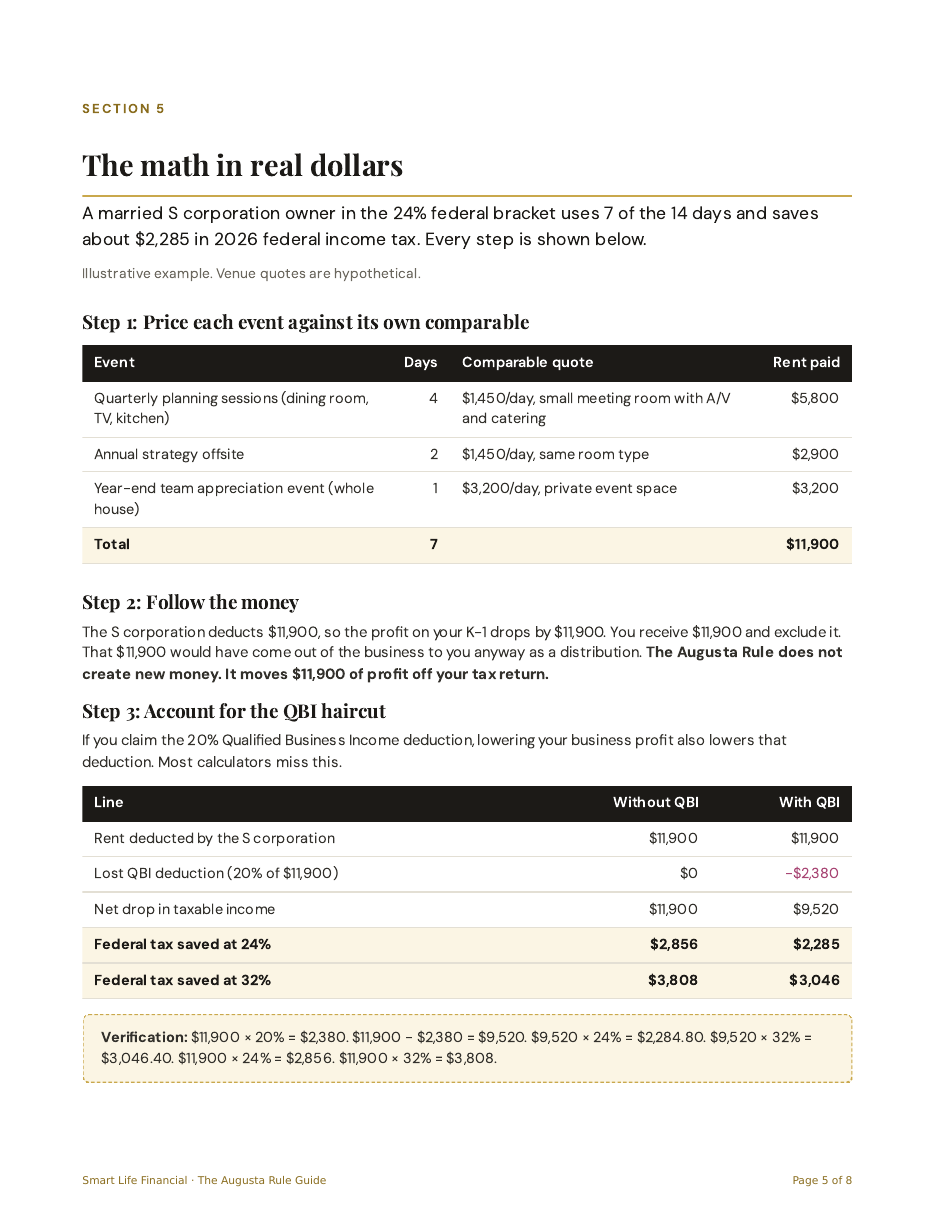
In this example, a married S corp owner in the 24% federal bracket uses 7 of the 14 days and saves about $2,285 in federal income tax for 2026. Here is every step. (Illustrative example; the quotes are hypothetical.)
Step 1: Price each event against its own comparable.
| Event | Days | Comparable quote (per day) | Rent paid |
|---|---|---|---|
| Quarterly planning sessions (dining room, TV, kitchen) | 4 | $1,450 small meeting room with A/V and catering | $5,800 |
| Annual strategy offsite | 2 | $1,450 same room type | $2,900 |
| Year-end team appreciation event (whole house) | 1 | $3,200 private event space | $3,200 |
| Total | 7 | $11,900 |
Step 2: Follow the money. The S corp deducts $11,900 of rent, so the profit on your K-1 drops by $11,900. You receive $11,900 and exclude it under Section 280A(g).
Here is the part most posts skip. That $11,900 would have come out of the business to you anyway, as a distribution. The Augusta Rule does not create new money. It moves $11,900 of profit off your tax return.
Step 3: Account for the QBI haircut. If you claim the 20% Qualified Business Income deduction, lowering your profit also lowers that deduction. Most calculators miss this.
| Line | Without QBI | With QBI |
|---|---|---|
| Rent deducted by the S corp | $11,900 | $11,900 |
| Lost QBI deduction (20% of $11,900) | $0 | −$2,380 |
| Net drop in taxable income | $11,900 | $9,520 |
| Federal tax saved at 24% | $2,856 | $2,285 |
| Federal tax saved at 32% | $3,808 | $3,046 |
Verification: $11,900 × 20% = $2,380. $11,900 − $2,380 = $9,520. $9,520 × 24% = $2,284.80. $9,520 × 32% = $3,046.40.
Step 4: Stretch it over time. At the 24% bracket with QBI, that is about $22,850 of federal tax over 10 years, before any state income tax savings. For 2026, the 24% bracket covers joint taxable income from $211,400 to $403,550.
Good money, not life-changing money. That is exactly why it belongs inside a bigger plan, which is where we go next.
The documentation checklist
An Augusta Rule deduction is won or lost on paper you created before the meeting, not a story you build after the IRS asks. Here is the file to keep for every rental day.
- Comparable quotes, in writing, gathered at the start of the year, one set per event type
- A rental agreement between you and the business: dates, rooms used, and the rate
- A board or company resolution approving the rental
- An agenda and attendee list for each meeting
- Minutes or meeting notes showing real business was done
- An invoice from you to the business for each rental
- Payment from the business account to your personal account, never cash
- A running day count for the home, staying at 14 or fewer across every rental, business or otherwise
- Reporting your CPA approves, which often means a 1099-MISC from the business and the exclusion shown on your return
One more caution. If you also take a home office deduction or reimbursement, keep the two separate. The home office covers a space used regularly and exclusively for work. Augusta days are distinct rental days for the rest of the home.
For business owners who want more: the tax-reduction stack
The Augusta Rule saves a few thousand dollars. The owners who cut their tax bill meaningfully stack several strategies that each follow the same principle: a real business expense, priced fairly, documented before the money moves.
| Strategy | Best fit | What it does | 2026 numbers to know |
|---|---|---|---|
| Augusta Rule | S corp, C corp, partnership | Business deducts rent; you exclude it | Up to 14 days per home |
| Hire your kids | Any entity; payroll tax break is narrower | Shifts income to a child's low bracket for real work at real wages | Child's standard deduction: $16,100 |
| Accountable plan | S corp and C corp owners | Company reimburses home office, mileage, phone; tax-free to you | No fixed cap; must be documented |
| Solo 401(k) | Owner-only businesses | Employee deferral plus employer profit sharing | $24,500 deferral; $72,000 total; +$8,000 catch-up at 50+ ($11,250 instead at ages 60–63) |
| Cash balance or defined benefit plan | High, steady profits, owners 45+ | Much larger deductible contributions than a 401(k) alone | Set by actuary based on age and income |
| Health Savings Account | High-deductible health plan | Deductible in, tax-free growth, tax-free out for medical | Limits set annually |
| Cost segregation and bonus depreciation | Owners of business real estate | Front-loads depreciation into early years | Property-specific study required |
| Reasonable salary review | S corp owners | Balances salary vs. distributions to manage payroll tax | Salary must be defensible for the role |
Two honest notes. Hiring your kids skips Social Security and Medicare tax only when the business is a sole proprietorship or a partnership owned by the parents and the child is under 18; in an S corp, normal payroll tax applies. And every row above has the same failure mode as Augusta: a guessed number and missing paper.
The bigger the deduction, the more it matters what happens on the back end. That is where most tax planning stops, and where mine starts.
The bigger picture: deductions today, a tax bill later
Some deductions are permanent wins. The Augusta Rule is one: that rent is never taxed. Others only move the tax to later.
Every pre-tax dollar in a Solo 401(k), a defined benefit plan, or an old IRA is a dollar the IRS still has a claim on. You deducted it at today's rate. You will pay tax on it, and on all of its growth, at whatever rate applies when you take it out. Required minimum distributions decide some of that timing for you.
So the real question for a business owner is not only "how much can I deduct this year?" It is "what does my lifetime tax bill look like, and when do I pay it?"
That is the work I do at Smart Life Financial. I build a personal model that shows, in real dollars:
- What your qualified accounts are projected to owe in taxes over your lifetime if nothing changes
- How Roth conversions, timed against your brackets, can move money out of the tax code on your terms
- How a Tax-Free Retirement Account (TFRA) strategy can reposition qualified money toward tax-free income
- How your Social Security timing, business exit, and estate plan fit into the same math
Here is one simple way the pieces connect. The roughly $2,285 a year the Augusta Rule saves in the example above can be set aside to pay the tax on a Roth conversion. One strategy funds the next.
If you own a business and want to see your own numbers, start at smartlifefinancial.com. I will show you the math nobody else shows you.
See your own numbers
If you own a business and want to see what your plan looks like in real dollars, start here.
Start at smartlifefinancial.com